As CADDA expands its work across the UK's animal, human and environmental diagnostics landscape, we have been considering the One Health approach. This is the position, formalised by the One Health Commission and embedded across UN, WHO and FAO policy, that human, animal, plant and environmental health are not separate problems but one interdependent system.
By: Tushar Jhanwar, Anastasios Tsaousis, William Edwards and Christian Hollingbery
What the workshop explored
Microbial diagnostics sit at the centre of that connection. The microbiome in a field of soil, in a cow, in a chalk stream and in the food chain is the same continuous biological conversation. The question is what we do with the data once we can read it: whether that reading can support farm resilience, water quality, antimicrobial-resistance work, and feed evidence back up the chain into the wider health system.
Workshop participants discussed two questions. Can UK farming support the wider health system? And what does a farm need to understand about its microbes before that knowledge can shape decisions on the ground?
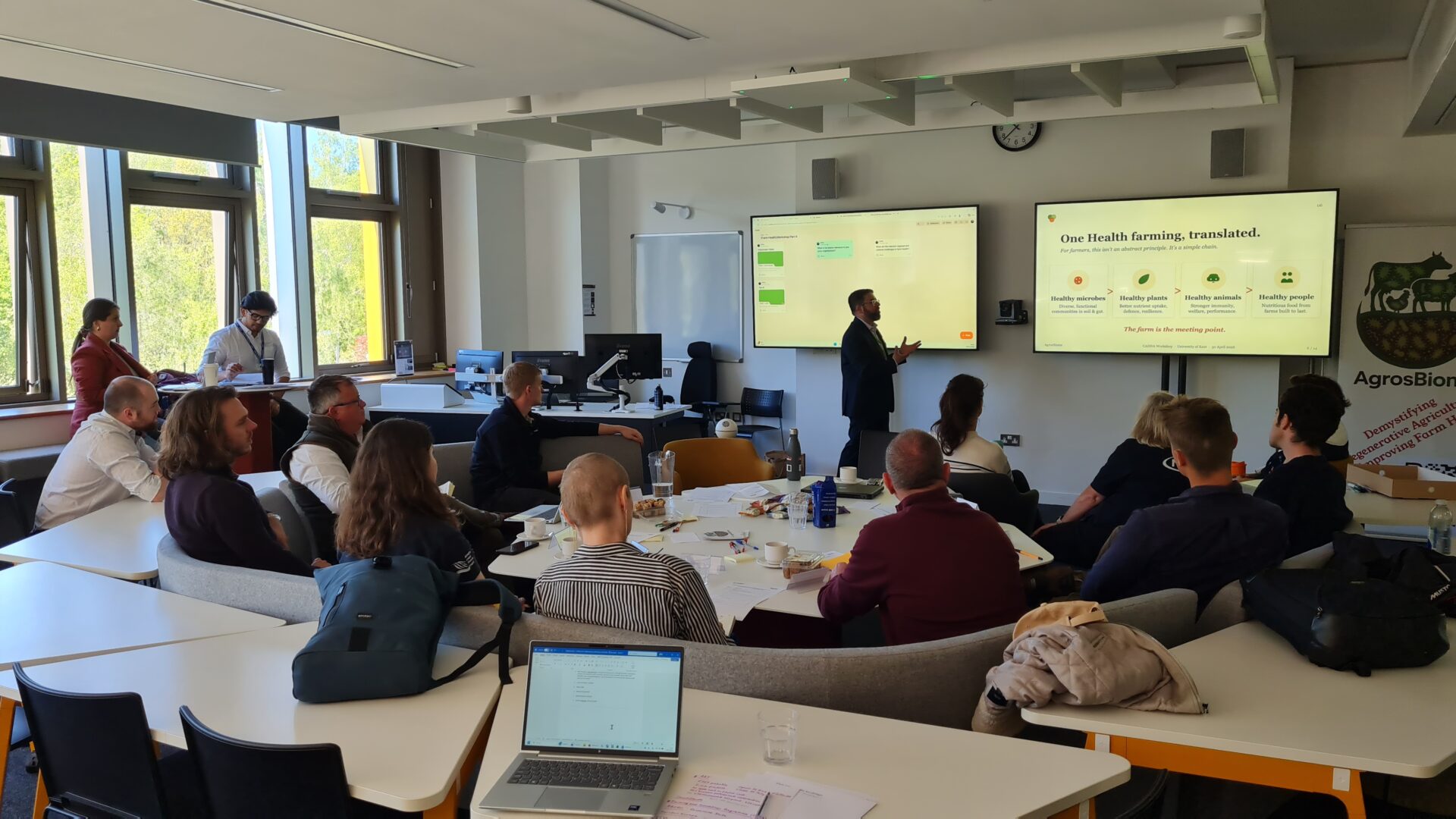
On 30 April, the workshop brought together a group of people who, between them, hold most of the picture.
What we did
The workshop was a stakeholder session for AgrosBiome, an early-stage University of Kent spin-out working to translate soil and livestock microbiome science into practical diagnostics for UK farms.
Hosted at the University of Kent and facilitated by CADDA and Kent Business School, the session sat inside CADDA’s broader work to grow UK diagnostics capability across the animal, human and environment interface. It was organised by Tushar Jhanwar (CADDA), Dr Anastasios Tsaousis (AgrosBiome CSO and head of the University of Kent microbiome group), and the AgrosBiome team.
Until now, AgrosBiome’s focus has been almost entirely scientific. The team has been building the laboratory methods and analytical pipelines that sit underneath the company’s soil and livestock microbiome diagnostics. With the science in a steady state, attention is shifting to the business-development side of things: how the diagnostics get used, who actually needs them, and how a young company should grow alongside the agricultural community it depends on. The workshop was a deliberate first step in that direction.
We used a facilitative modelling approach grounded in Problem Structuring Methods (PSM) and Soft Systems Methodology (SSM), built for situations where many people see different parts of the same problem. Participants worked through a One Health framing input, a live stakeholder mapping activity over twelve sectors, and a discussion about collaborations that could begin now.
Who was in the room
Farmers from multi-enterprise operations across Kent, water companies and catchment partnerships responsible for chalk streams and groundwater draining agricultural land, farm advisers and agronomists working between research and practice, researchers from the University of Kent across biology and management science, knowledge transfer and wildlife advisory bodies, and local government with rural-economy and environment briefs.
Get in touch
Materials and emerging collaboration ideas will be shared with participants in early summer. If your work touches farm health, microbial diagnostics, catchments, antimicrobial resistance, agricultural policy or One Health more broadly, we’d like to hear from you.
AgrosBiome: https://www.agrosbiome.com
Contact: Dr Anastasios Tsaousis, A.Tsaousis@kent.ac.uk