
Light. It’s something we take for granted in our everyday lives. But perhaps what is less evident to many of us is the role that light plays in healthcare diagnostics. At the very basic level, a clinician observing symptoms of disease in a patient is making a diagnosis facilitated by light. However, in recent years the use of light as a diagnostic tool has been greatly advanced through targeted optics and photonics research.
A number of these tools and how they are being developed further formed the contents of a successful one-day workshop organised by the Centre of Advanced Diagnostic Development and Application (CADDA) and the Applied Optics Group at the University of Kent on 10th March 2026. CADDA brought together representatives from the research community, healthcare practitioners and the diagnostics industry to discuss developments and opportunities for further exploitation of the diagnostic properties of light.
A theme across the day was the benefits of employing light at different wavelengths to identify diseased tissues or tumours. Professor Elson of Imperial College London described how the combination of optical spectroscopy and micro-surgery has led to greater precision in the removal of tumours, using light as a label-free diagnostic tool. Patient benefits from this highly targeted surgery are very clear.
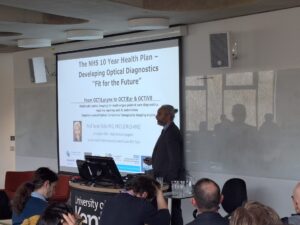
Patient care is also at the heart of the NHS 10-year plan, in which decentralisation of diagnostics is a core aim. Professor Tatla from London North West Hospitals NHS Trust used the example of how high street opticians were leading the way in deploying optical coherence tomography to screen patients prior to signposting to clinical specialists where necessary. In the UK we have a real opportunity to develop and deploy diagnostics that support localised triaging of a many conditions, and we can be confident the industry will step up to the challenge.
As a further example of the diversity of optically-based diagnostics, Dr Alex Thompson of Imperial College London described a technique for assessing gut ‘leakiness’ associated with poor nutrition. Detection of fluorescent markers in blood using a ‘smart watch-type’ device can be used to monitor permeability of the gut lining associated with conditions such as irritable bowel syndrome or Chron’s disease.
While diagnostics for human healthcare were the major topics of the workshop Neciah Dohr of FluoretiQ broadened the scope to veterinary diagnostics, specifically the detection of urinary tract infections in domestic pets. Targeting of antibiotics, whether in animals or humans, is of paramount importance as we try to reduce the rise of antibiotic resistance across a range of pathogens. FluoretiQ address the challenge of detecting antimicrobial susceptibility by using a total internal reflectance approach to visualise changes in bacterial behaviour in the presence of antibiotics. This novel use of photonics brings rapid detection of antibiotic susceptibility much closer to deployment in veterinary and human healthcare clinics.

The above summary captures only some of the exciting applications of optics to healthcare diagnostics that are already in clinical trials or use. Delegates were also exposed to the continuing advance of optical technologies for diagnostic purposes by Professor Podoleanu and colleagues from the Applied Optics Group within the University of Kent. The workshop provided fascinating insights of the interaction between light and biological materials for diagnostic purposes and perhaps initiated discussion that will foster new applications.