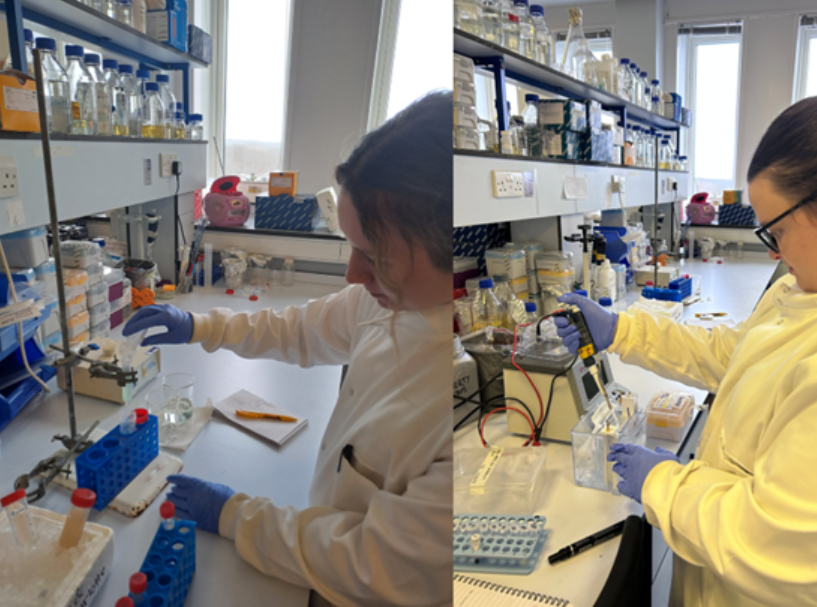
Grace and Charlotte in the lab. Left – Grace carrying out a protein purification. Right – Charlotte loading an SDS PAGE to analyse the produced protein.
By David Beal, University of Kent
In addition to problems such as habitat loss, human-animal conflict and poaching Amur tigers are at risk from viral pathogens such as Canine Distemper Virus (CDV). CDV has been observed in wild populations of tigers since 2003 and it has been suggested that, with a mortality rate of 30%, it could increase the 50-year extinction probability by 65%. Significant effort, supported by WVI, has gone into understanding and developing methods for tracing exposure to CDV in wild populations but this has proven difficult with the facilities available near to the field.
To enable greater understanding of exposure of big cats to Canine Distemper Virus in the wild WVI and Wild Cats Conservation Alliance have funded a multidisciplinary project between the University of Kent (Charlotte Dalzell, Dave Beal, Jess Bodgener, Grace Lelliott and Mark Smales) and University of Cornell (Martin Gilbert). The aim of this project is to produce rapid diagnostic devices, such as enzyme linked immunosorbent assays (ELISA) and lateral flow assays (LFT) that can be used in or near to the field, to show previous exposure to the CDV virus.
Grace: I am enjoying learning lots of laboratory skills and the possibility of helping make a diagnostic device for big cats is really exciting.
Grace and Charlotte are undertaking research Masters degrees, at the University of Kent, with a focus on developing these tools. As such this project is not only necessary for the conservation of Tigers but great training for both Grace and Charlotte’s future work in conservation/diagnostics. The project is lab based and requires them to genetically modify bacteria to produce proteins that exist on the CDV surface. This complex series of experiments which requires them to connect small segments of DNA, the material which encodes for all proteins, together before inserting it into bacteria. At this point Grace and Charlotte can prompt the bacteria, using chemicals, to make the CDV protein. This process has many pitfalls and is a challenge to complete. They have made great progress so far and have started to use these modified bacteria to produce the proteins of interest.
Charlotte: I am so happy with the steps I have made so far in this project. I am currently in the process of protein purification which can later be used in ELISA assay. I love this project because I get the opportunity to be a part of improving conservation and welfare of animals. This project can help be the groundwork on developing a vaccine of tigers against CDV bring the species one step away from extinction.
Future work will be to test if these proteins are able to be recognised by CDV antibodies in a lab setting before working with other partners to test Tiger samples.
Learn more about the Wild Cats campaign here: Room to Roam: Securing a Future for Big Cats | Big Give Earth Raise Campaign 2026