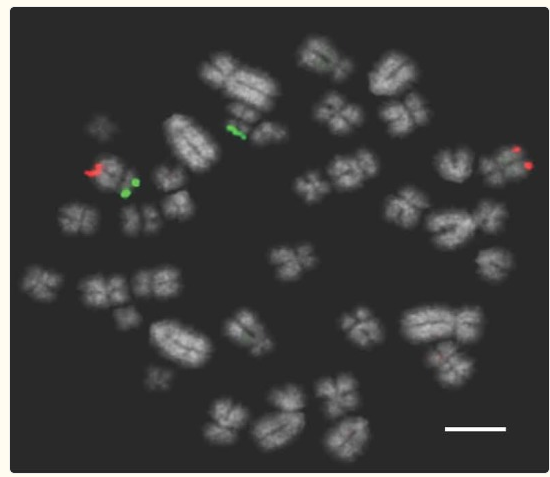
The University of Kent—operating as CytoScreen Solutions—provides a premier genetic screening service that safeguards breeding fertility in livestock, with a particular focus on pigs. Combining decades of cytogenetics expertise and innovations in laboratory design, our service applies multi-colour FISH (fluorescence in situ hybridisation) to identify chromosomal abnormalities that threaten reproductive success.
The global pork sector is enormous: pig meat represents over 30% of all meat produced worldwide, and the pig‑farming market was worth approximately USD 3.15 billion in 2024, with Europe contributing just under 1/3 of this. Balanced reciprocal translocations are a specific type of genetic abnormality that affects roughly 0.5% of boars used in artificial insemination and up to 1.6% in general populations. These genetic anomalies can reduce litter sizes by as much as 45%, leading to significant economic losses for breeders—often thousands of pounds per week per farm.
Reciprocal translocations can be easily detected by FISH, because they “swap” the end of one chromosome for another Kent’s in-house FISH platforms use fluorescent probes to specifically label genomic regions near each end of each pig chromosome, identifying even translocations that are too small to be detected by earlier methods such as chromosome banding: so-called “cryptic” translocations. Using this technology, we collaborate closely with several leading pig‑breeding companies and veterinary genetics providers to screen stud animals from around the world. Within the UK, Ireland, and parts of mainland Europe we operate as a direct diagnostic provider, receiving samples and assaying them within our University of Kent laboratories. For more distant global regions, we supply pre-assembled FISH devices, allowing them to carry out screening of their own local pig herds.
In the last year, our services included screening over 760 breeding pigs and supplying 460 FISH profiling devices to foreign partners. We maximise our impact by screening animals within the core “genetic nucleus”
herds of each breeding company, identifying low-fertility sires before they impact wider breeding programmes. Each of the stud pigs we validate will in turn go on to sire hundreds or even thousands of offspring with assured genetic status, with their offspring in turn magnifying the impact still further. In the coming year, we plan to expand further by partnering with a major diagnostics company in Spain to improve our service availability across the EU.
Our service isn’t merely diagnostic—it supports ongoing research and development. Revenue from screening underwrites both the refinement of our protocols and fundamental academic research into animal genetics at Kent. Recently, a team led by Frances Burden and colleagues used a technique called Hi-C to detect how the DNA of each chromosome is folded into the cell nucleus. This arrangement is altered by chromosomal abnormalities. The resulting paper, titled “Detecting chromosomal rearrangements in boars using Hi‑C” was published in Animal Genetics. This work showed that high‑throughput Hi‑C sequencing applied to fresh or frozen blood samples can effectively detect both reciprocal translocations and more challenging rearrangements occurring within the body of each chromosome. This will in time offer a complementary, higher‑resolution method to supplement FISH-based screening.
By enhancing sample detection—even under sub‑optimal shipping or handling conditions—and delivering rapid, reproducible results, Kent’s service minimises risk for breeders. As global demand for pork remains strong, reliable fertility screening is critical. Kent continues to lead in livestock cytogenetics, delivering robust, research‑driven services and technology that support both industry needs and academic discovery.